Abbott Labs to Split Into Two – The Wall Street Journal.

I thought you would be interested in the following story on WSJ.com.

Abbott Labs to Split Into Two

http://online.wsj.com/article/SB10001424052970204485304576640740820288766.html

The Wall Street Journal Mobile Reader for iPhoneTM delivers the latest global news, financial events, market insights and information to keep you ahead of the curve. Get the information you depend on plus entertainment, culture, and sports coverage when, where, and how you want it from the most credible source for news and information. Click below to download the WSJ Mobile Reader for free from the iTunes App Store.

http://www.wsj.com/iphoneinstall

From iPod. Pls excuse brevity.
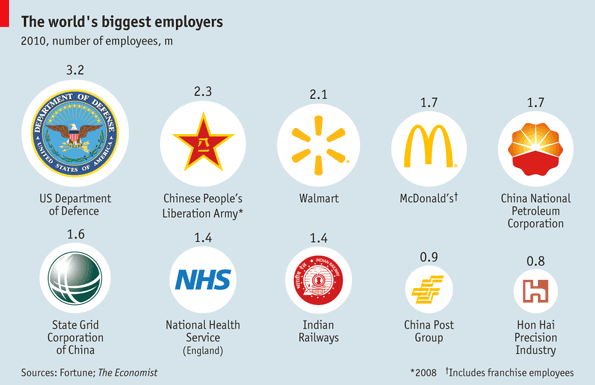
Walmart is world’s third largest employer

LECTURE NOTES

This PDF file contains all the slides that I will present during the course, plus some that I won’t present, but that may be discussed in class or using the board.
260Lectures Fall 11.pdf

Management styles in China

The message is ready to be sent with the following file or link attachments:

Privatization in China ECON0911.pdf

China PC Market Tops U.S.

This articles provides some updates to the industry environment in the China MSFT case we discussed. How has the industry structure changed?

“China PC Market Tops U.S.”

US: Business News

COMMENT: To Integrate or Not – that is the IT question

In one week, The Economist argued two sides of a coin (not uncommon for economists…), admittedly using two industries as evidence:

  • In IT and computers, they see good reason for leading companies to move “up the stack” and divest commodities like PCs in favor of software and services. Classic case: IBM. Current case: HP. See Seismic shift in Silicon Valley.
  • In another article, they saw good reason for Google to get into handset hardware by buying Motorola, even if those are commodities. The reason they cite is that this industry might not play out like PCs. And, in relaying the argument, they make a point about Google using the hardware position to further its software growth of Android and related services. See Patently Different.

The key difference between these examples and industries is the stage of maturity of the technology and competitive landscape. In PCs, the value chain has stopped evolving and the software standards are more or less stable – hence little role for owning integrated hardware and software. In smartphones this is not so yet, but getting there fast.

Frankly, the least mature field is tablets/pads: watch for Google to move into THAT direction with its new Motorola hardware knowledge. If it doesn’t go in that direction, it is more likely to spin off the Moto handset in short order, much like HP and IBM did with their mature hardware businesses.

ARTICLE: Bad Strategy Perils — McKinsey

Nice article on how the idea and terms of “strategy” are overused. Don’t fall into these traps!
Bad Strategy Perils McKQ0611.pdf

NEWS: ITT Breakup — WSJ

ITT has a long history of acquisitions and spin-offs, as one of the original “conglomerates” in American business. The latest spin-offs are described in this article.
ITT Breakup Jan2011 WSJ.pdf

ANALYSIS: Mining Equip Makers Global Strategies — WSJ

Different companies, in the same industry, but with different strategies, especially in terms of their global activities. Follow this story, as there have been updates….
Mining Equip Makers Global Strategies WSJ0310.pdf

ARTICLE: Best Parent Strategy — McKinsey

The natural combination of the ideas of corporate advantage and acquisition strategy leads to the idea of “best parent firms.” See this article for elaboration; there is also an HBR article on this theme.
Best Parent Strategy McKQ00.pdf